
RRN Science Workflows: WFI Data Simulations#
This science workflow guides users through the simulation, processing, manipulation, and visualization of Roman WFI imaging data products.
Important: To run this workflow, start a medium server in the RRN.
Workflow Overview#
-
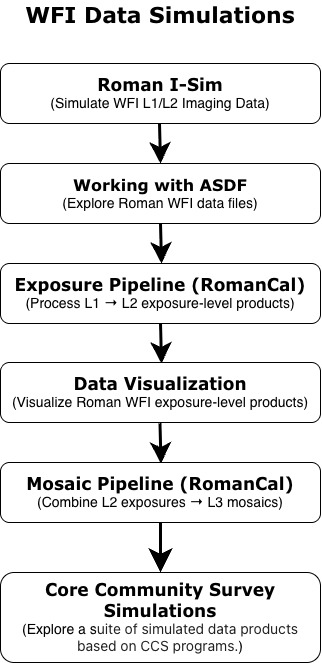
Simulate Roman WFI raw (L1) and exposure-level (L2) products using Roman-I-Sim, a GalSim-based simulator for WFI imaging data. Roman I-Sim uses Galsim to render astronomical scenes, STPSF to model the point-spread function, and CRDS reference files to apply instrument calibration effects. Simulations can be generated from either synthetic catalogs or Gaia-based catalogs. Outputs are written in the standard Roman ASDF format.
-
Explore Roman WFI data products stored in the Advanced Scientific Data Format (ASDF). This step introduces the structure of Roman WFI ASDF files, including metadata, data arrays, and provenance information, and applies to both simulated and future flight-like data products. To learn more, visit the RDox pages on Roman WFI data levels and products.
-
Process Roman WFI raw (L1) data into exposure-level (L2) products using RomanCal, the Roman science calibration pipeline. This stage corrects instrumental effects and collapses ramp data into rate images suitable for scientific analysis. To learn more about the overall exposure level pipeline visit the RDox documentation.
Data Visualization
Visualize Roman WFI exposure-level products using Matplotlib and Jdaviz. This step focuses on quick-look inspection and basic analysis of calibrated L2 images. Imviz is based on the Jupyter platform and includes built-in Astropy functionality. For additional background information, consult Jdaviz documentation on ReadTheDocs.
-
Combine multiple exposure-level (L2) products into mosaic-level (L3) images using RomanCal. The mosaic pipeline aligns, distortion-corrects, and coadds individual detector exposures to produce deeper, wide-field images. To learn more about the overall mosaic level pipeline visit the RDox documentation.
Explore a suite of simulated data products based on downscaled versions of the Roman Core Community Survey (CCS) programs. These simulated products were created to test the SOC data pipelines and provide sufficient scientific fidelity. These simulations do not necessarily include everything that may be observed on-orbit. Specifically, the simulations do not include time-variable sources. More details on what is included in the simulations are provided in the descriptions of each simulation set.
Caveats and limitations#
Caveats and Limitations
This workflow focuses primarily on WFI imaging simulations.
The fidelity of simulated products depends on the calibration reference files available at the time of simulation.
Processing steps and outputs may evolve as Roman calibration software and reference data mature.
Last Updated: December 2025